Shaping the Future of Finance: Exploring the Next Era of Financial Innovation
Financial innovation is reshaping how people, companies and organizations spend and receive money, the services provided to them and how they transact business dealing with international markets. Modern financial ecosystems are moving towards being faster, smarter, and more inclusive, with the digital payments and AI-driven analytics being only the tip of the iceberg, having been served by the concept of decentralized finance and embedded banking. Not only are these developments improving customer experiences but also allowing organizations to streamline operations, improve security and make data-driven decisions in an ever-competitive world.
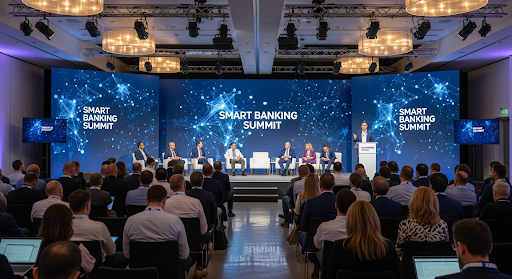
As technology continues to evolve, collaboration and knowledge-sharing platforms, such as a smart banking event, play a vital role in shaping the future of the financial sector. . The events unite leaders, innovators, and policymakers in the industry to pursue emerging trends, solve challenges, and develop strategies that help to ensure sustainable growth and digital transformation in the entire global banking environment.
Smart Banking Event: Fintech Driving Innovation
A smart banking event is a driver of change as it provides a linkage between the financial institutions and the technology providers with regulators and thought leaders. Such events lead to teamwork, the introduction of new technology, and give an insight to the changing customer expectations. The involvement of such events helps organizations to have a competitive advantage and devise mechanisms to cope with fast digital transformation.
1. Competence in the field of Emerging Technologies.
Artificial intelligence, blockchain, and biometric authentication are some of the new innovations in financial services that are being highlighted with smart banking events. Visitors obtain the direct experience of using the tools that can improve fraud detection, automation, and customer personalization. Knowing these technologies will help institutions to upgrade infrastructure, enhance efficiency, and remain competitive in a fast-changing digital economy.
2. Building connections with Industry Leaders.
These conferences unite executives, founders of fintech, regulators, and technology professionals in the entire financial ecosystem. Networking possibilities enable the participants to form collaborations, exchange expertise, and consider introducing joint initiatives. Through such connections, organizations are finding new solutions, new areas to grow, and enhancing their presence in the international financial services community.
3. Regulatory Developments Understanding.
Financial regulations are dynamic in relation to the developments in technology. The event of smart banking offers regulators and policymakers an opportunity to deliberate on compliance terms, data protection levels, and cybersecurity models. Participants can also understand regulatory expectations, enabling them to ensure their strategies match the legal expectations and still remain efficient in their operations and win the trust of their customers.
4. Presentation of Innovative Solutions.
The technology providers can showcase innovative solutions that address the contemporary banking issues through these platforms. Ranging, among other things, to digital onboarding tools to high-tech analytics, the attendee can assess the tools, which enhance operational flexibility and customer satisfaction. The exposure assists the decision-makers to choose technologies that support their business objectives and long-term transformation purposes.
Technology in Modern Banking Transformation
Financial innovation is centred on technology, and it allows institutions to provide faster, more secure, and personal services. Digital tools are transforming the traditional banking models, starting with cloud computing and predictive analytics. By adopting the said technologies, organizations can improve efficiency in their operations and minimize expenses, as well as consumer interaction, and stay conflict-free in a competitive environment.
Key Technological Banking Innovations
1. Automation and Artificial Intelligence.
Artificial intelligence facilitates the work process by automating repetitive work, enhancing fraud detection, and allowing predictive analytics. Chatbots and virtual assistants improve customer service by responding to their inquiries immediately and making personalized recommendations. These features enable financial institutions to give effective services at minimal cost of operations and with more accuracy.
2. Blockchain of Secure Transactions.
The blockchain technology increases financial transaction transparency and security. It also minimizes fraud by maintaining unalterable records and eases cross-border transactions. Modern financial innovation is built on blockchain as financial institutions use it to enhance trust and improve the settlement process, as well as to guarantee data integrity.
3. Banking Solutions based on the cloud.
Cloud computing will provide a scalable infrastructure whereby banks can store data safely and offer services within a short time. It facilitates remote processes, improves teamwork, and minimizes the cost of IT maintenance. The use of clouds allows financial institutions to become more innovative at a quicker rate and ensure high security and resilience in their operations.
Digital Innovation to improve Financial Inclusion
Electronic financial systems are increasing the reach of banking, especially in low-access areas. Mobile banking, digital wallets, and microfinance apps enable people and small businesses to become a part of the formal financial system. This inclusiveness leads to economic development, inequality, and sustainable development amongst communities.
How Financial Inclusion is promoted by Digital Innovation
1. Accessibility of Mobile Banking.
Mobile banking allows people to conduct transactions, pay bills, and access financial services through smartphones. This availability eradicates the geographical constraints and offers banking services to remote groups of people. By reaching more people, financial institutions will be able to provide services to more customers and make economies more independent.
2. Digital Wallet Adoption
Digital wallets make the transaction easier since users can store money, make payments, and transfer money safely. They lower the use of cash and enhance financial transparency. In the case of small businesses, the digital wallets increase the efficiency of payment and allow the companies to engage in the digital economy.
3. SME Support and Microfinance.
Microloans and financial services to small businesses and entrepreneurs are done through digital platforms. Availability of credit enables individuals to initiate or grow businesses to generate jobs and propel economic growth. The financial institutions are able to contribute to the development of the community by providing inclusive financial products.
Final Thoughts
Financial innovation has continued to revolutionize the banking picture across the globe and the banks have facilitated the provision of smarter, more inclusive, and safer services. Financial institutions can overcome the digital revolution and continue to cope with a shifting market by adopting the new technologies, supporting teamwork, and being customer-centered.
Conferences such as The World Financial Innovation Series (WFIS) – Vietnam are significant to promoting industry discussion and presenting revolutionary solutions. This banking conference event brings together the world’s experts and innovators, encouraging collaboration and helping to create future-ready financial ecosystems that spur sustainable growth and technological innovation.