450 Units Is a Range, Not a Number
| TL;DR A sales estimator answers how many. A profit calculator answers how much per unit. Neither answers the other.One worked unit nets $5.79. At 300, 450 and 600 units that is $1,737, $2,605 and $3,474 a month.Screen on demand first, then gate on margin before doing any deep research.The federal agency that publishes retail sales data publishes the error alongside the estimate. Your estimator does not, and the uncertainty is still there. Short version: the two tools multiply together, and multiplying a confident margin by an uncertain volume produces a number that looks like a forecast and behaves like a guess. |
Ask a sales estimator what a product does and it will tell you 450 units a month. It will not tell you 300 to 600, which is the honest answer, and the difference between those two framings is the difference between a decision and a bet.
The sequence for combining the two tools is set out in this comparison of the Amazon sales estimator vs. profit calculator.
Two Tools, Two Questions
They do not overlap, and the confusion comes from both producing dollar figures.
A sales estimator takes a Best Sellers Rank and returns estimated units. It also shows sales and revenue trends at the ASIN level, how demand distributes across competitors in a category, and how seasonal the whole thing is. What it cannot tell you is whether any of those sales made anybody money.
A profit calculator takes your costs and returns net profit per unit, margin, ROI, and how sensitive those are to fees, advertising and returns. What it cannot tell you is how many units exist to be sold.
Multiply the second by the first and you have a monthly profit figure. That figure inherits all the uncertainty of the estimator and none of its caveats, which is the specific way this goes wrong.
Watch the Multiplication
The destination page works a unit and then runs it at three volumes.
The unit: $29.99 selling price, $8.50 unit cost, $1.50 inbound shipping, $4.50 referral fee, $4.20 fulfillment, $4.50 PPC, $1.00 for returns and other costs. Net profit $5.79, a 19.3% margin.
| Monthly units | Monthly profit |
| 300, downside | $1,737.00 |
| 450, expected | $2,605.50 |
| 600, upside | $3,474.00 |
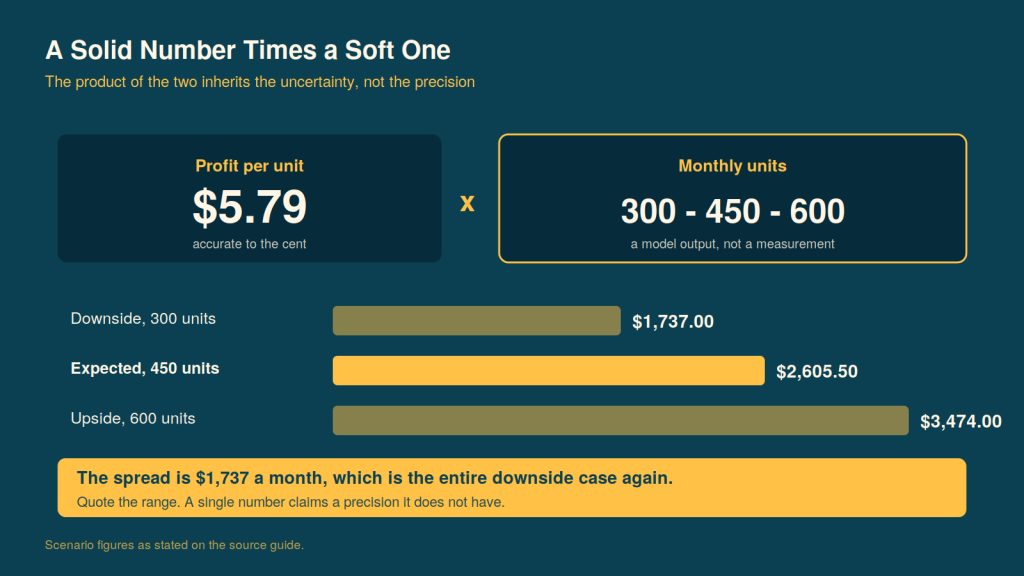
One input is accurate to the cent. The other is a model output. The product inherits the second.
The per-unit figure is solid. You control the price, you have the supplier quote, the fees are published, and the only soft input is the ad cost. Call it accurate to a few cents.
The unit count is not that. It is a model output derived from rank, and the spread from downside to upside is $1,737 a month, which is the entire downside scenario again.
State both. A plan that says “$2,605.50 a month” is claiming a precision it does not have, and the fifty cents on the end is the tell. A plan that says “somewhere between $1,700 and $3,500, most likely near $2,600” is describing the same thing accurately, and it is the version you can make a sourcing decision against, because it tells you what happens if you are wrong.
The Agencies That Publish Sales Data Publish Their Error Too
Worth borrowing a habit from people who do this professionally, and this is an analogy rather than a statement about Amazon.
The Census Bureau publishes US retail sales every month. Its methodology documentation is unusually direct about what an estimate is: “the published estimates may differ from the actual, but unknown, population values. For a particular estimate, statisticians define this difference as the total error of the estimate.”
It goes further, in a passage that describes exactly the situation a seller is in. Its sample “is one of a large number of samples of the same size that could have been selected using the same design,” and if all possible samples had been surveyed, “estimates derived from the different samples would, in general, differ from each other.”
And the line that should make anyone cautious about a single-number estimate: “the sampling error of an estimate can usually be estimated from the sample, whereas the nonsampling error of an estimate is difficult to measure and can rarely be estimated. Consequently, the actual error in an estimate exceeds the error that can be estimated.”
That is a federal statistical agency, with mandatory reporting and a designed sample, telling you the real error is bigger than the error it can quantify. A rank-based sales estimator has none of those advantages. It is inferring volume from a public ranking through a relationship that varies by category and moves over time.
None of which makes estimators useless. They are the only demand signal available and they are far better than intuition. It makes the single number the problem, not the tool.
Which One to Run First
The order depends on what you are doing, and there are two defensible sequences.
Demand first, when screening many ideas. Twenty candidate products, most of which will fail. Run the estimator across all of them, cut the ones without enough volume to matter, and then apply a quick margin gate before investing real research time in the survivors. The gate is the important half: demand alone is not a pass, and a high-volume product with no margin is the most expensive kind of mistake because it is also the most convincing.
Margin first, when the cost risk is obvious. Heavy, bulky, fragile, or anything where the fee structure looks punishing. If the margin cannot work at any plausible volume, the demand number is irrelevant and you have saved yourself the research.
Then return to demand once supplier quotes arrive, because a real quote replaces the assumption the first margin pass was built on, and the answer sometimes changes.
Where the Sequence Breaks
Three failure modes, and they are all versions of taking one number too seriously.
Treating an estimate as a forecast, which is the whole subject of this article.
Screening on demand and never running the margin gate, which produces a shortlist of popular products you cannot make money on.
And running the margin calculation once, at the quoted cost, before freight and duty and advertising are known. That is not a margin, it is a best case, and best cases are what get ordered by the container.
The Check Before You Commit
One question, asked out loud, before any purchase order.
At the downside volume, does this product still make enough money to be worth doing? Not at the expected volume. At the bottom of the range.
If the answer is yes, the decision is easy and the upside is free. If the answer is no, you are not evaluating a product. You are hoping for one, and hope is not something a calculator can price.